Fuel Markers & Product Integrity
Invisible Fuel Markers in Pakistan
How They Work and Why They Matter
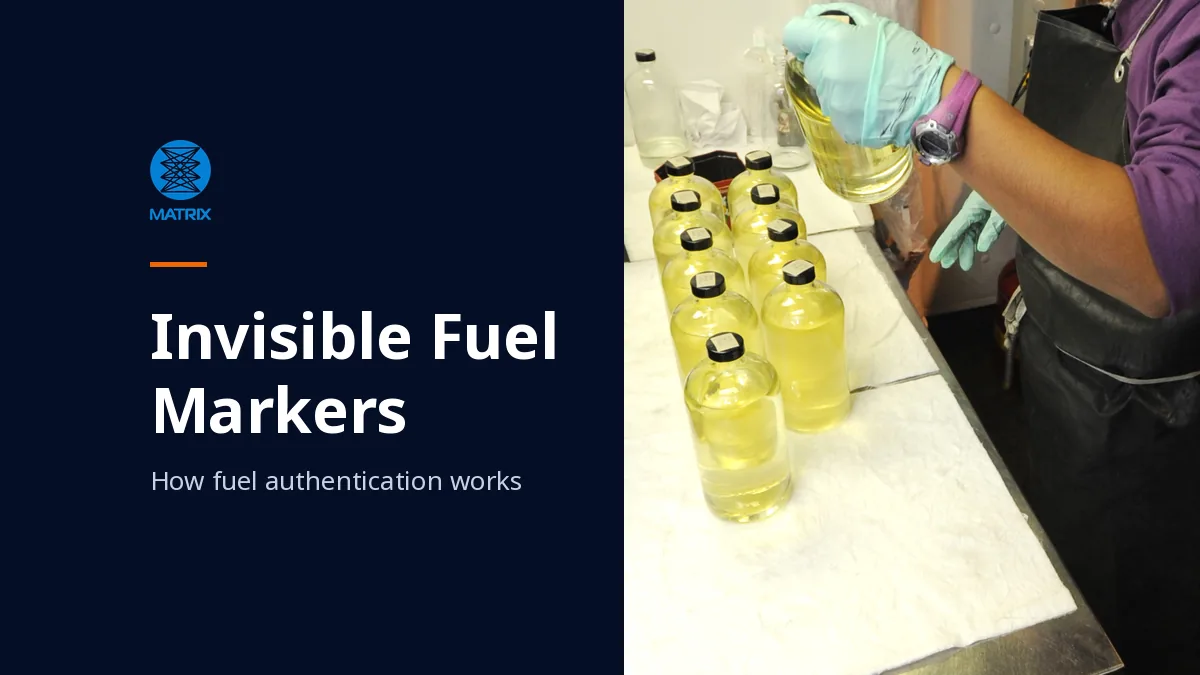
A fuel delivery arrives with the correct paperwork. But how can a supplier check that the product itself is consistent with what left the terminal? Invisible fuel markers help answer that question by placing a detectable chemical signature within the fuel.
For oil marketing companies and distributors in Pakistan, this creates an additional way to verify product identity and investigate possible dilution. Understanding the technology starts with two questions: is the expected marker present, and is its concentration consistent with the marked supply?
What Are Invisible Fuel Markers
Invisible fuel markers are specialised chemical substances added to fuel at a defined concentration. They provide an identifying signature that can be detected later using a compatible test or instrument.
A visible fuel dye changes the product’s colour. An invisible marker provides an identification feature that cannot be checked by sight alone. A sample may look unchanged while carrying a marker that a suitable test can detect.
This makes marking useful for authentication: checking whether a sample is consistent with an authorised marked supply. Its value depends on the whole programme, including accurate dosing, representative sampling and a reliable method of interpreting the results.
Types of Fuel Marker Testing
Qualitative and quantitative describe the information a marker test provides. They do not necessarily identify separate chemical families of markers.
Qualitative testing checks whether the expected marker response is present. It supports an initial authentication check, such as examining a sample collected from a delivery or retail location. A positive result confirms detection within the method’s capabilities; it does not establish that the fuel meets every quality requirement.
Quantitative testing measures how much marker is present. Comparing this concentration with an established reference can help identify inconsistencies and investigate possible mixing or dilution. Suitable instrument-based systems can provide this type of measurement.
| Testing approach | What it checks | Typical use |
|---|---|---|
| Qualitative | Whether the expected marker is detected | Initial product authentication |
| Quantitative | The concentration of the marker | Monitoring consistency and investigating dilution |
Consider a simple example: marked fuel is mixed with unmarked material. If the marker remains stable and the mixture is uniform, its concentration falls. A suitable quantitative test may reveal that change, giving the supplier a reason to investigate. The reading alone does not identify the added material or establish the cause.
Why Fuel Markers Matter in Pakistan
For a Pakistani fuel business, marking adds evidence about the product reaching its network. It supports checks that a delivery is consistent with the authorised supply, alongside its volume and paperwork.
This is particularly useful when investigating suspected adulteration, which involves the unauthorised addition of other material. Marker results can help a supplier decide whether to collect further samples, examine delivery records or arrange additional laboratory analysis.
There is also a direct connection to brand reputation. Customers judge a fuel brand by what they receive at the pump. A structured testing programme gives the supplier a practical way to examine concerns and follow up irregularities with evidence.
Recorded results become more useful over time. For example, repeated unexpected readings at one location can help a business prioritise an investigation there. This gives managers a clearer basis for deciding where to focus their checks, without assuming that every unusual result has the same explanation.
How Fuel Marking Works in Practice
A programme begins by selecting a marker and testing method suited to the fuel and the business objective. The marker is introduced under controlled conditions at an agreed point in the supply chain. Samples are then collected at selected locations and tested against the expected response or concentration.
Recording where and when samples are taken allows teams to compare results with delivery records. Markers do not provide continuous location tracking; visibility comes from connecting tests at known points.
Unexpected readings require careful interpretation. Dosing accuracy, mixing, sampling and measurement uncertainty can affect the result. Follow-up checks help distinguish a product concern from a problem with the marking or testing process.
Fuel authentication also sits alongside wider quality testing. Detecting the expected marker does not confirm every fuel property, so the relevant quality tests remain necessary.
John Hogg Technology for Fuel Authentication
John Hogg’s PURECHAIN system connects fuel marking with field testing and digital records. Its COVERTRACE markers provide the detectable signature within the fuel, while the CT4 detector supports rapid qualitative checks in the field.
The PURECHAIN app and data platform connect detector readings with records that can be reviewed across the programme. This helps teams move beyond an isolated test result and examine patterns that may need attention.
A field reading can prompt a repeat sample, while recurring findings can guide a wider review. Quantitative monitoring requires a marker, instrument and validated method that support concentration measurement.
Fuel Marker Solutions Through Matrix in Pakistan
Matrix Private Limited offers John Hogg fuel-marker technology in Pakistan, providing a local point of contact for organisations exploring fuel authentication and dilution monitoring.
To explore a fuel-marking programme for your operation, connect with Matrix through our refinery and fuel chemical solutions page.